
Silk crepe: crepe de Chine, georgette or heavy crepe?
Crepe de Chine, georgette, crêpe drap: three silks woven with the same tightly twisted yarn, and three uses. What sets them apart, their weights on our pages and how to sew them.
Nathalie
Fabric Expert
6 min read
Silk crepe is a family: silks woven with very tightly twisted yarns, which give them a texture and a drape of their own. Georgette, grainy and sheer, makes layered dresses; crepe de Chine, fine and soft, makes blouses; heavy crêpe drap, thick and matte, makes trousers and straight dresses.
Between our finest georgette and our crêpe drap, the weight goes from 43 to 171 g/m², four times as much, and both are called crepe. The name is not enough to choose by, and neither is the weight.
A yarn twisted up to 3,000 times per metre
It all starts with the yarn. To make a crepe yarn, several strands of raw silk are put together and twisted as far as they will go, 1,500 to 3,000 turns per metre according to the vocabulary of the International Centre for the Study of Ancient Textiles, where an ordinary weft yarn has 80 to 150. They are then woven with the two directions of twist alternating, usually two yarns twisted one way, two the other, so that the fabric does not skew.
In finishing, those yarns try to untwist and they contract. The surface ripples ever so slightly: that is crepe’s texture, a matte relief that reflects less light than a satin, and it is where its spring and its drape come from.
Crepe de Chine vs georgette vs crêpe drap: what’s the difference?
It comes down to where the crepe yarn sits in the weave. The weights are those on our product pages, converted to g/m², with their equivalent in momme, the unit silk is weighed in.
| Georgette | Crepe de Chine | Crêpe drap | |
|---|---|---|---|
| The crepe yarn | in warp and weft | in the weft only | in the weft, over a lustrous warp |
| To the eye | matte, grainy, sheer | fine grain, soft lustre | matte on both sides |
| Drape | light, springy | fluid, follows the body | heavy, falls straight |
| Ours, ≈ g/m² | 43–80 | 67 (96 for the heavy one) | 171 |
| ≈ momme | 10–18 | 15 (22) | 39 |
| Width | 122–140 cm | 130 cm (140 for the heavy one) | 140 cm |
| Made into | layered dresses, sleeves, lined blouses | blouses, dresses, scarves | straight dresses, trousers, jackets |
The range has other 100% silk crepes too. Fluid silk crepe weighs about the same as our crepe de Chine, 69 g/m², and comes in some fifteen colours, 137–140 cm wide. Satin-backed crepe, matte on one side and satiny on the other, weighs about as much as crêpe drap; we covered it with our evening dress fabrics.
Georgette: a matter of texture more than weight
The word suggests a light veil, and our finest georgettes do weigh 43 g/m². But others, 130 cm wide, weigh 69, and one goes up to 80, more than our crepe de Chine. So it isn’t lightness that makes a georgette. It is the crepe yarn running both ways, in warp and weft, which gives it a more pronounced grain and more spring than crepe de Chine.
In the hand, it is dry, slightly rough, and bounces back when you crumple it. Grainier and less sheer than chiffon, it slips less under the scissors and is easier to cut. Choose its weight by what you ask of it. Our lightest silk georgettes, around 10 momme, make sleeves, stoles and layered skirts; the heaviest, 69 to 80 g/m², a blouse or a dress that covers more.
In its lighter weights it stays sheer, and that is its main drawback. A georgette dress needs a lining, unless it is worn over a slip, and it can be lined with itself: a printed georgette over a plain one keeps all its drape. Its seams show through, so make them French seams. For the hem, forget the classic double turn, too bulky on a sheer fabric. Roll it by hand over a few millimetres, or use the overlocker’s rolled hem; by hand it takes time, but it is the lightest hem. Mark with tacking thread rather than chalk, and never with waxed chalk, which stains georgette.
Crepe de Chine, the blouse crepe
Here the crepe yarn is only in the weft, over a barely twisted warp, which gives crepe de Chine a finer grain than georgette and a soft lustre. In the hand it is soft and cool; on the body it flows and moves with you. At 15 momme it covers well enough for a blouse or an unlined dress in mid tones.
Our 100% silk crepe de Chine is woven in France, 130 cm wide; the heavy crepe de Chine, from Italy, reaches 22 momme for a dress that must cover more. It slips a little when cut, which tissue paper is enough to fix.
Crêpe drap, the crepe that falls straight
It is the heaviest of the three, and the most muted. Over a lustrous silk warp, a matte crepe weft covers almost all the shine; what remains is a dense fabric, matte on both sides, that falls straight and keeps the line of a clean cut. You will also find it called drap or cady, and in English our product pages call it silk crepe cloth. A straight dress, wide trousers, a jacket, a simple wedding dress: that is its ground.
At 171 g/m², it weighs two and a half times as much as our crepe de Chine. Heavier, it is also warmer, which makes it the silk crepe for cooler seasons. Our crêpe drap is all 140 cm wide, in about a dozen colours.
Sewing silk crepe
Cut in a single layer, on a sheet of tissue paper, pinning the pattern through both. The paper holds the crepe, which no longer slides away under the scissors. Keep the pins inside the seam allowances, as silk keeps their marks.
At the machine, a fine new needle does most of the work. A 60/8 or 65/9 Microtex for georgette, a 70/10 for crepe de Chine, a 70/10 or 80/12 for crêpe drap. Shorten the stitch, 1.5 to 2 mm on georgette, 2 to 2.5 mm elsewhere, and keep the fabric taut in front of and behind the foot, without pulling. Crepe de Chine takes French seams too; crêpe drap, pressed-open seams with neatened edges.
Nathalie’s tip: before cutting, steam a 10 cm square offcut with your iron, let it dry flat and measure it. If it has shrunk, ban steam from the whole project, hem included: press dry, at one dot, on the wrong side and under a pressing cloth.
For a first garment in silk crepe, start with crepe de Chine. A blouse cut on the straight grain, French seams, an iron without steam, and georgette and crêpe drap will feel familiar afterwards.
Happy sewing,
Nathalie
Shop the fabrics
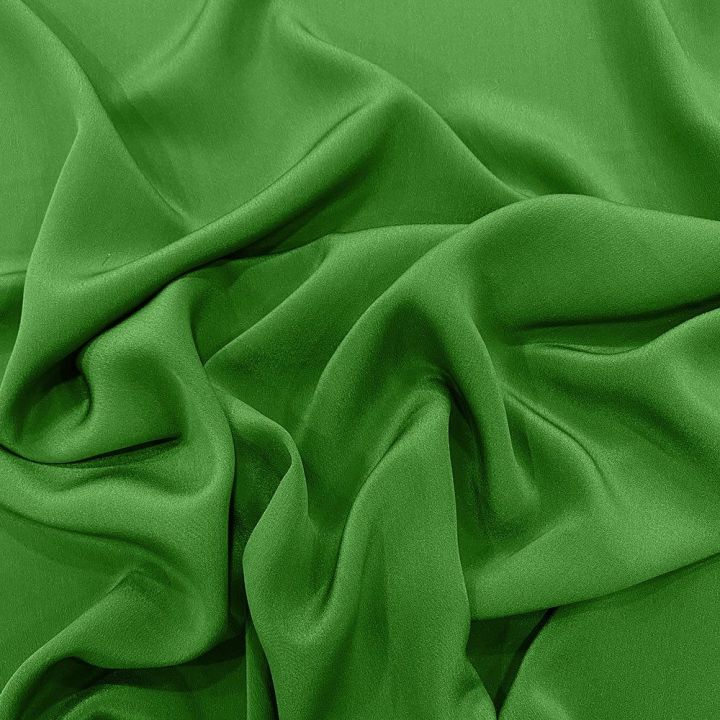
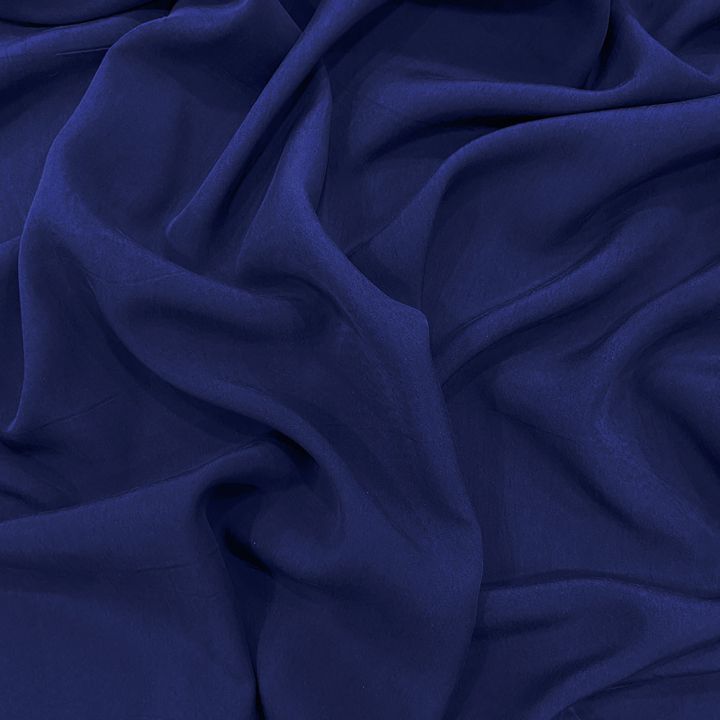
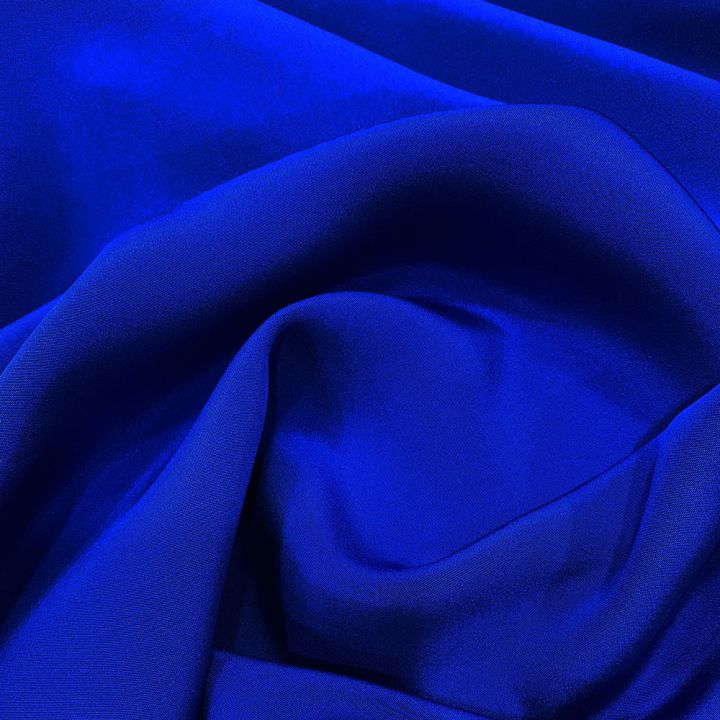
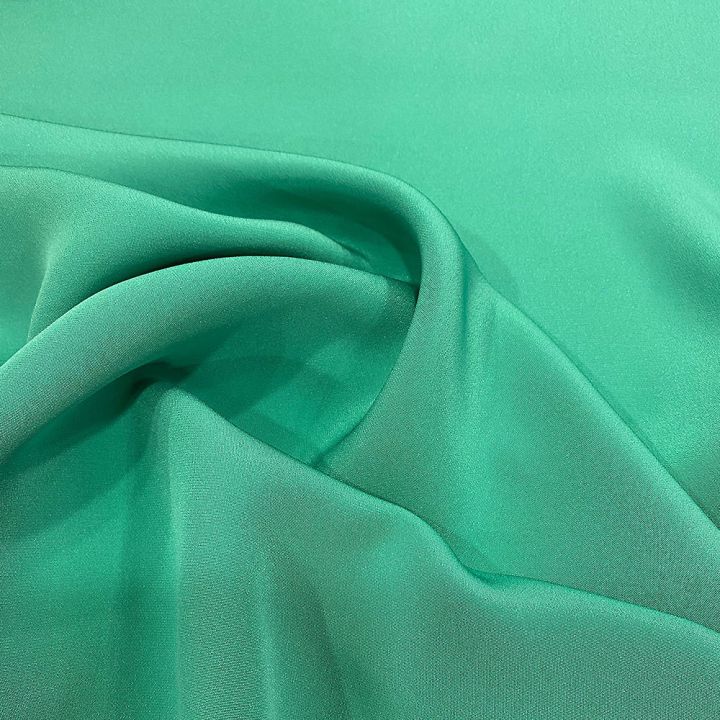
Fabrics in this article
Related articles
You might also like

What is tweed fabric, and how do you sew it?
Tweed means two fabrics: Scottish wool cloth and the fancy tweed of the Chanel jacket. What our tweeds really contain, and how to sew them without relying on the iron.

Silk velvet vs cotton velvet: which one to choose?
Same price per metre, two fabrics with almost nothing in common. What silk velvet is really made of, what gives cotton velvet its body, and how to sew each one.

Satin vs silk: what’s the difference?
Satin is a weave, silk is a fibre. Six satins from our shelves compared, from polyester to silk, and the reliable ways to tell whether a satin is really silk.