
Silk velvet vs cotton velvet: which one to choose?
Same price per metre, two fabrics with almost nothing in common. What silk velvet is really made of, what gives cotton velvet its body, and how to sew each one.
Nathalie
Fabric Expert
5 min read
In our shop they cost the same per metre and have almost nothing in common. Silk velvet flows and follows the body: it’s the velvet of evening dresses and kaftans. Cotton velvet very nearly stands up on its own: it’s the velvet of jackets and trousers. Choose the silhouette first, and the velvet will follow.
You do need to know what you’re buying, though. Our silk velvet is 82% viscose and 18% silk, like most fabrics sold under that name. Velvet made entirely of silk does exist, but it has become rare, and the price shows it.
Our two velvets side by side
Weights are taken from our product pages, in grams per linear metre, and converted to g/m² so that different widths can be compared.
| Silk velvet | Cotton velvet | |
|---|---|---|
| Fibre content | 82% viscose, 18% silk | 100% cotton |
| Weight | 238 g/ml, 140 cm wide, i.e. 170 g/m² | 380 g/ml, 145–150 cm wide, i.e. 253–262 g/m² |
| Price per metre | €34.99 | €34.99 |
| In the hand | supple, slippery, almost liquid | firm, dense, with body |
| In the light | glints that shift with every fold | deep colour, a quieter sheen |
| For | evening dress, kaftan, kimono, maxi skirt | jacket, blazer, trousers, straight skirt, cushions |
For the same price, cotton gives you half as much fabric again per square metre. Silk gives you the drape.
Silk velvet, the one that flows
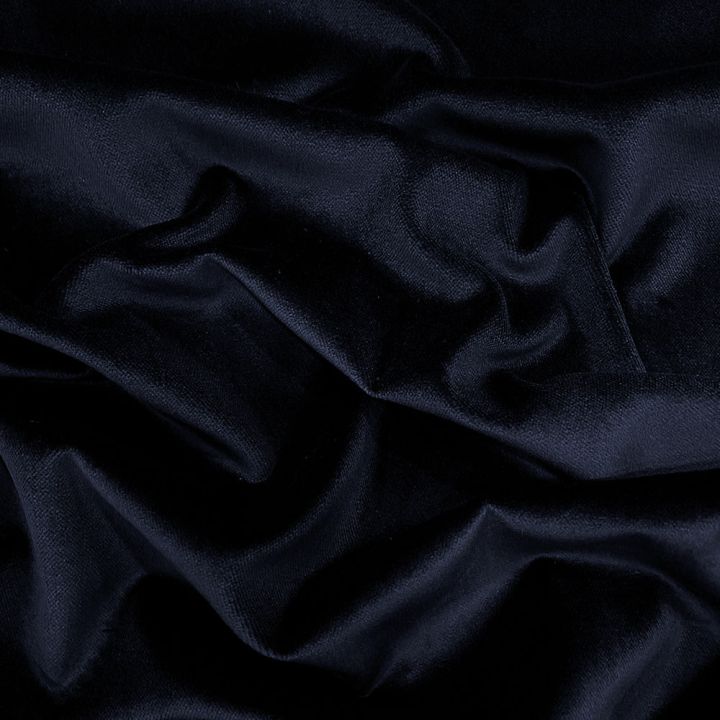
Velvet is woven with an extra warp whose threads form the pile, the short upright fur that makes it so soft. On velvet looms, two cloths are often woven face to face, joined by that pile, and then separated by cutting the pile threads in half. In a silk velvet like ours, the pile, which carries most of the weight, is viscose, and the silk forms the ground.
Viscose makes a glossy, supple pile for far less than silk would cost, and it’s the pile that makes this velvet so fluid. It even makes devoré possible: a printed gel eats away the viscose in places and leaves the silk ground untouched, which is how you get velvet patterns on a sheer base.
The downside of all that fluidity? It marks. A tight fold, an evening spent sitting, a hand laid flat, and the pile lies down, leaving a paler patch. Steam lifts most of it back up, as long as the iron never crushes it. For a kaftan or a long dress that needs to move, we can’t think of a better choice; for trousers you sit in all day, there are better ones.
Cotton velvet holds its shape
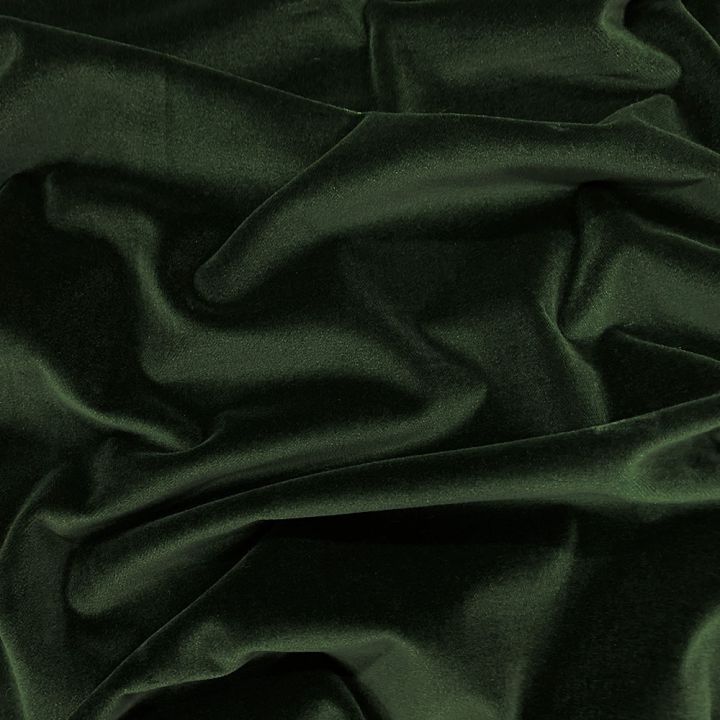
Cotton velvet is a different fabric altogether. At 380 g/ml, it has the firm, dense hand of a woollen broadcloth, keeps the shape of a shoulder, a lapel or a patch pocket, and its colour stays deep, without silk velvet’s shifting glints. It’s the velvet for blazers, straight trousers, A-line skirts, winter pinafore dresses, and cushions that need to last.
It is heavier on the body and in the seams, which get thick wherever they cross. Line a jacket with something slippery, or the sleeve will catch on your jumper. Our article on linings covers the choice between cupro and acetate. And if you want a party velvet on a budget, try our panne velvet at €11.99 a metre, a blend of acetate, polyamide and elastane with a crushed pile that catches the light, and it stretches.
Sewing velvet: what changes
Velvet has a direction, and everything starts there. Run your hand over it. One way it feels smooth and soft, which is the direction of the pile; the other way, it resists. Cut with the pile running up, it looks darker and richer; with the pile running down, lighter and shinier. Both work, as long as every piece runs the same way, or a sleeve will look a different shade from the back. Allow a little more fabric than for a plain cloth, since the pieces can no longer be laid top to tail.
Cut in a single layer, wrong side up, and never on the fold. Velvet sheds as you cut, so keep the vacuum cleaner handy. Pins leave marks in the pile, so put them in the seam allowances, or better still, tack.
It’s at the machine that the two velvets part ways. Right sides together, the pile of the two layers grips and makes them slide against each other. The top layer creeps forward, the bottom one lags behind, and the seam ends up several millimetres out. Silk velvet is the trickier one, light and slippery. Tack it by hand before stitching, lighten the presser foot pressure, use a 70/10 Microtex needle and a 2.5 mm stitch, and sew in the direction of the pile. Cotton velvet slips less but weighs more. A walking foot helps it feed through in one piece, an 80/12 needle and a 3 mm stitch cope better with the thickness, and the seams need grading, trimming each allowance to a different width, so they don’t form a ridge.
That leaves the iron, the pile’s worst enemy. Never put it on the right side. Press from the wrong side, with steam and barely any pressure, the velvet laid pile down on a thick terry towel or on a scrap of the same velvet, pile up. To open a seam, a finger and some steam are often enough.
Nathalie’s tip: before you cut anything, chalk an arrow on the wrong side of every piece, in the direction of the pile. Once the pieces are cut from the length, the only way to find the direction again is to stroke them one by one.
Frequently asked questions
Can you wash silk velvet?
Ours, yes, by hand. Don’t wring it, dry it flat with the pile facing up, and store it rolled rather than folded, because a crease in velvet shows for a long time. Cotton velvet goes in the machine at 30 °C.
Which velvet for trousers?
Cotton velvet. It has enough body to hang straight and copes with being sat in, while silk velvet would soon mark at the knees.
Velvet is chosen by hand far more than on a screen. Run your fingers over a sample of each, one way and then the other, and you’ll know which one belongs in your project.
Happy sewing,
Nathalie
Shop the fabrics
Fabrics in this article

Related articles
You might also like

Satin vs silk: what’s the difference?
Satin is a weave, silk is a fibre. Six satins from our shelves compared, from polyester to silk, and the reliable ways to tell whether a satin is really silk.

Best lining fabric: cupro or acetate, garment by garment
Cupro or acetate? What our two linings are really like, their actual weights and care, and which one to choose for a coat, a jacket, a dress or a skirt.

Dupion or slub dupion: what’s the difference?
Same silk, same weight, almost the same width: it all comes down to the thread. How to recognise slub dupion, and which to choose for a dress, a jacket or curtains.