
g/ml or g/m²: how to convert a fabric’s weight
g/ml tells you what the metre you buy weighs, g/m² what the fabric itself weighs. The formula, a table by width, and when to look at which.
Nathalie
Fabric Expert
6 min read
To go from g/ml to g/m², divide the weight per linear metre by the width in metres: 112 g/ml on a 137 cm width gives 112 ÷ 1.37, or about 82 g/m². The first figure tells you what the metre you buy weighs, the second what the fabric itself weighs. Our product pages now show both.
For a long time, our pages only spoke g/ml, grams per linear metre (nothing to do with millilitres). That makes sense for a shop that sells by the metre, much less for you, since most fabric sellers quote g/m², often called GSM, and that is how many of you compare. Hence the little i that has appeared next to the weight, and this guide to what it calculates.
Two ways of weighing the same fabric
g/ml is one metre unrolled from the bolt, across its full width, laid on the scales. g/m² is the same fabric brought back to a square one metre each way. Both describe the same cloth; only the width, measured from one selvedge to the other, sets them apart.
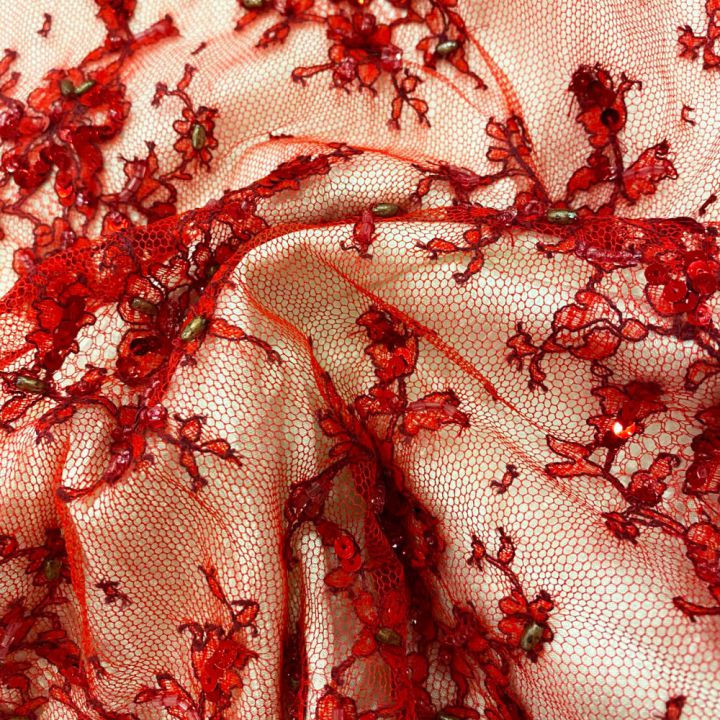
That gives a simple rule. Above one metre of width, the figure in g/m² is smaller than the one in g/ml, and that is the case for nearly all our fabrics, most of them 130 to 150 cm wide. Below it, the opposite happens. Our beaded Chantilly Calais laces, 80 to 85 cm wide, show 260 g/ml and weigh about 315 g/m². At exactly one metre, the two figures are the same.
The formula, both ways
g/m² = g/ml ÷ width in metres
g/ml = g/m² × width in metres
Take our silk dupion, listed at 110–115 g/ml on a 137 cm width. Take the middle of the range, 112.5 g/ml. Write the width in metres, 1.37. Divide: 112.5 ÷ 1.37 = 82.1. The dupion weighs about 82 g/m², which is exactly the figure its page shows.
Noted 80 g/m² on a fabric seen elsewhere? On a 140 cm width, that makes 80 × 1.4 = 112 g/ml, the weight of our dupion give or take a few grams. And if the figure comes from an American pattern, in ounces per square yard (oz/yd²), multiply it by 33.9, so a 12 oz denim weighs about 407 g/m².
Without a calculator, two rules of thumb will do. On a 150 cm width, take off a third, so 300 g/ml makes 200 g/m². On 140 cm, take off a little under 30%. Above all, keep the width in metres: dividing 112.5 by 137 instead of 1.37 gives 0.82 g/m², a fabric that would blow away in the first draught. And beware of a bare “g/m”, which you will see used for either.
g/ml to g/m² conversion table
The table covers the widths you will find at our shop, from Calais laces, often 90 cm wide, to woollens at 150 cm. Results are rounded to the gram.
| Weight (g/ml) | 90 cm wide | 115 cm wide | 140 cm wide | 150 cm wide |
|---|---|---|---|---|
| 30 | 33 g/m² | 26 g/m² | 21 g/m² | 20 g/m² |
| 60 | 67 g/m² | 52 g/m² | 43 g/m² | 40 g/m² |
| 90 | 100 g/m² | 78 g/m² | 64 g/m² | 60 g/m² |
| 120 | 133 g/m² | 104 g/m² | 86 g/m² | 80 g/m² |
| 150 | 167 g/m² | 130 g/m² | 107 g/m² | 100 g/m² |
| 200 | 222 g/m² | 174 g/m² | 143 g/m² | 133 g/m² |
| 250 | 278 g/m² | 217 g/m² | 179 g/m² | 167 g/m² |
| 300 | 333 g/m² | 261 g/m² | 214 g/m² | 200 g/m² |
| 400 | 444 g/m² | 348 g/m² | 286 g/m² | 267 g/m² |
| 500 | 556 g/m² | 435 g/m² | 357 g/m² | 333 g/m² |
Which one should you look at? It depends on the question
To compare two fabrics, g/m², without hesitation. It cancels out the width, which varies from one bolt to another, even within a single family.
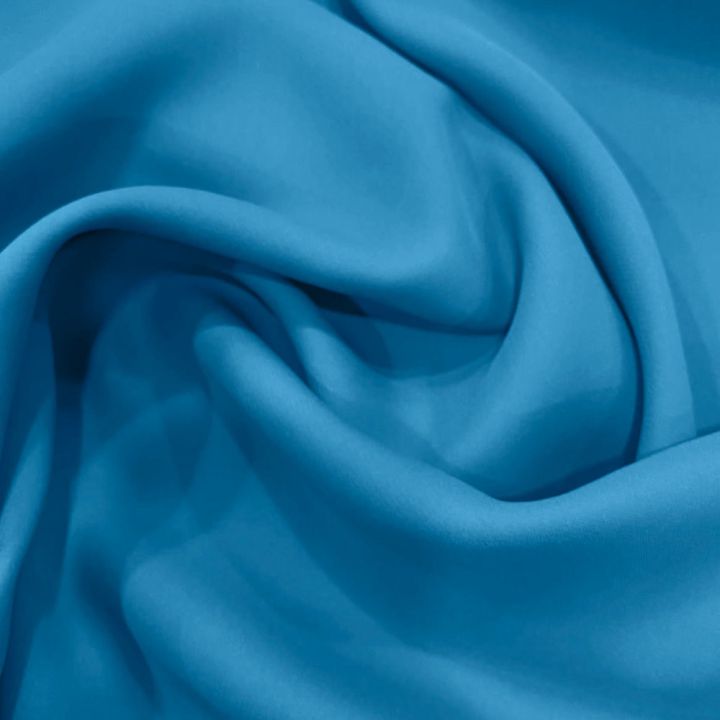
Take two of our 100% silk crepes. The azure blue shows 215 g/ml, the forest green 205, and you would bet on the first one for a dress that needs to hang heavy. Wrong. The forest green is only 114 cm wide, against 130 to 135 for the azure; per square metre, it weighs 180 g/m² against 162. Eleven per cent is not a different fabric, but it is enough to turn the ranking round.
To know what you are going to wear, or hang, g/ml is more direct. Multiply it by the length you buy and you have the weight of the fabric before cutting. If your coat pattern asks for 2.5 m of a double-faced wool crepe at 465 g/ml, you will be cutting into 1.2 kg of cloth. g/m² would not have told you that without the width.
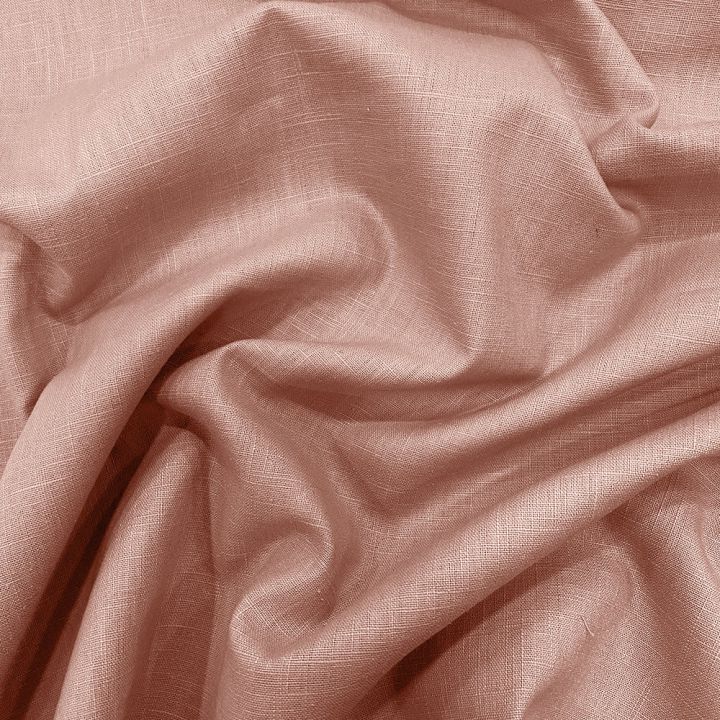
Nathalie’s tip: for curtains, do this sum before choosing the pole and the rings. Two 2.60 m panels in our pure linen at 310 g/ml make 5.20 m of fabric and 1.6 kg to carry, lining not included.
For silk, g/m² is what leads to momme, and it is all in our guide to momme.
On our product pages, both at once
In each fabric’s specifications, the Weight line stays in g/ml. Right next to it is a little i: hover over it, or tap it on a phone, and the equivalent in g/m² appears, worked out from the width. On the dupion, that gives “≈ 82 g/m² (grams per square metre)”.
Why keep g/ml first? Because we sell by the metre. It is the weight of each metre that goes into your parcel.
When the width is given as a range (135–140 cm), the calculation takes the middle, then the result is rounded to the gram. Above all, this g/m² is an average over the whole width, selvedges included. On a scalloped lace or a fabric with a border, a square cut from the middle of the piece will not necessarily weigh the same.
Where our fabrics sit
To give you a sense of scale, here is the most common weight in a few families, taken from the fabrics in stock as we write.
| Family | Weight on the page | Width | Equivalent |
|---|---|---|---|
| Silk organza | 30 g/ml | 137–140 cm | ≈ 22 g/m² |
| Silk chiffon | 33 g/ml | 137 cm | ≈ 24 g/m² |
| Silk taffeta | 90 g/ml | 140 cm | ≈ 64 g/m² |
| Silk dupion | 110–115 g/ml | 135–140 cm | ≈ 82 g/m² |
| Cotton poplin | 180 g/ml | 145–150 cm | ≈ 122 g/m² |
| Satin-backed crepe | 224 g/ml | 138–140 cm | ≈ 161 g/m² |
| Brocade | 233 g/ml | 135 cm | ≈ 173 g/m² |
| Wool crepe | 315 g/ml | 145–150 cm | ≈ 214 g/m² |
| Pure linen | 310 g/ml | 135 cm | ≈ 230 g/m² |
| Duchess satin | 365 g/ml | 150 cm | ≈ 243 g/m² |
| Cashmere | 490 g/ml | 140–150 cm | ≈ 338 g/m² |
| Tweed | 638 g/ml | 145–150 cm | ≈ 433 g/m² |
These figures tell you the weight, not the drape. Satin-backed crepe and brocade are within a dozen grams of each other, and yet the first flows down the body while the second keeps whatever shape you give it. Organza, which looks more substantial than chiffon, even weighs a little less.
A weight tells you a lot, not everything. The hand, the drape, the way light catches the fabric: none of that fits in a number, and to judge it, order a sample. If you are torn between two fabrics for a particular project, write to us and we will help you decide.
Happy sewing,
Nathalie
Shop the fabrics
Fabrics in this article

Related articles
You might also like

Silk momme: what is it, and how do you calculate it?
Momme measures how much a square metre of silk weighs. Where it comes from, how to work it out from our weights in g/ml, and what it does (or doesn’t) tell you about a fabric.

Dupion or slub dupion: what’s the difference?
Same silk, same weight, almost the same width: it all comes down to the thread. How to recognise slub dupion, and which to choose for a dress, a jacket or curtains.