
Dupion or slub dupion: what’s the difference?
Same silk, same weight, almost the same width: it all comes down to the thread. How to recognise slub dupion, and which to choose for a dress, a jacket or curtains.
Nathalie
Fabric Expert
5 min read
Slub dupion is a dupion woven with a more irregular thread: its thicker, randomly spaced slubs draw ribs that catch the light. Classic dupion has slubs too, but discreet ones, under a smoother sheen. Same silk, same weight; the difference is in the look.
On paper, almost nothing sets them apart. Both our dupion families weigh 110–115 g/ml, about 82 g/m² or 19 momme, are 100% silk and carry the same care symbols. In the hand, you will not mix them up for long.
Side by side
| Dupion | Slub dupion | |
|---|---|---|
| Slubs in the thread | fine, sparse | thick, very marked, randomly spaced |
| Look | calm surface, even sheen | raised ribs that catch the light |
| Weight | 110–115 g/ml (≈ 82 g/m²) | 110–115 g/ml (≈ 82 g/m²) |
| Width | 135–140 cm | 135–140 cm |
| Composition | 100% silk | 100% silk |
Where do dupion’s slubs come from?
The word comes from the Italian doppione, “double”, and in the US it is usually spelt dupioni. Sometimes two silkworms spin their cocoon together, and the thread reeled from these double cocoons is irregular, thicker in places. In dupion, this thread is the weft, the one running from one selvedge to the other, on a fine, even warp. So the slubs run across the width of the fabric, in short strokes.
Nobody tries to smooth them out. They give dupion its dry, slightly crisp hand and its body: it keeps the folds you give it, and the ones you don’t, because it creases quickly.
Slub dupion, a dupion that owns its slubs
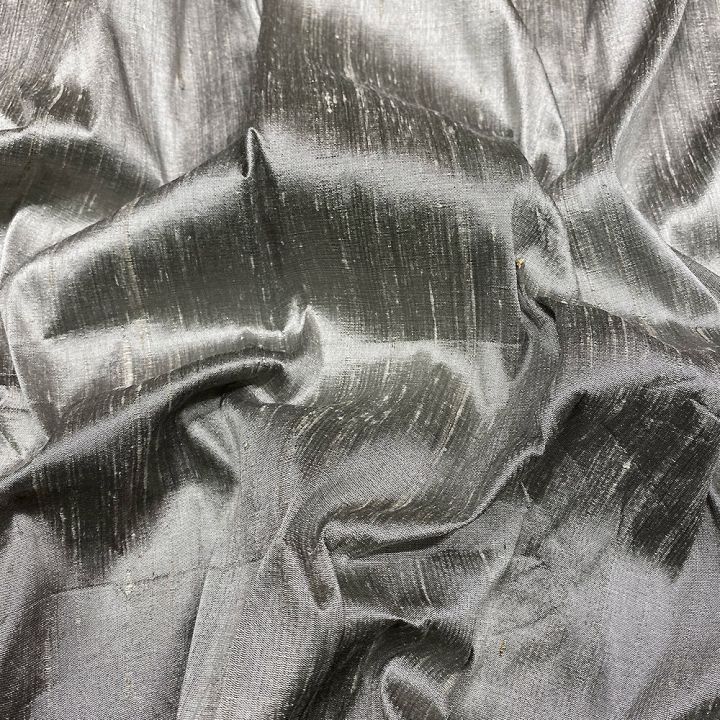
In spinning, a slub yarn is one whose thick places are made on purpose, for the effect they give the fabric. Our slub dupion takes that idea all the way. Its slubs are thicker, spread irregularly along the whole length, and form very pronounced ribs. Laid flat, they look like pencil strokes drawn freehand from one selvedge to the other, with here and there a paler fleck where the thread suddenly thickens.
How much these ribs show depends on the colour. On the silver grey, they catch the light at every movement and the fabric looks almost metallic. The raw white shows them very well too. On the black, you have to look for them against the light, and from a few steps away it could pass for a classic dupion.
There is a catch, and we might as well say it straight away. The slubs fall where they like. Two perfectly symmetrical jacket fronts are out of the question, and a big rib can land in the middle of a back.
If you like clean surfaces, slub dupion will annoy you.
If you like a fabric with texture, this is the one. Our slub dupions come from India, in nearly twenty colours, and their texture reads best on the pale shades and the silver grey.
Classic dupion, the same silk in a quieter mood
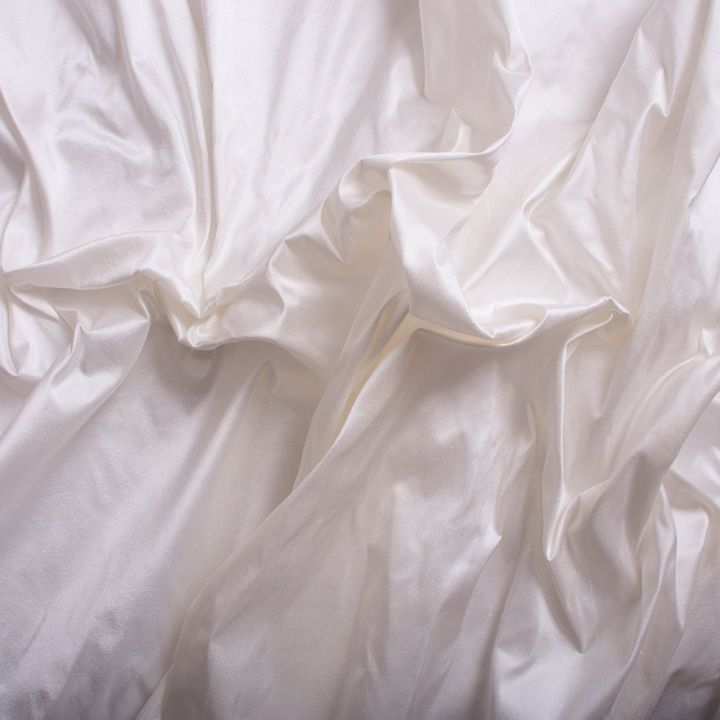
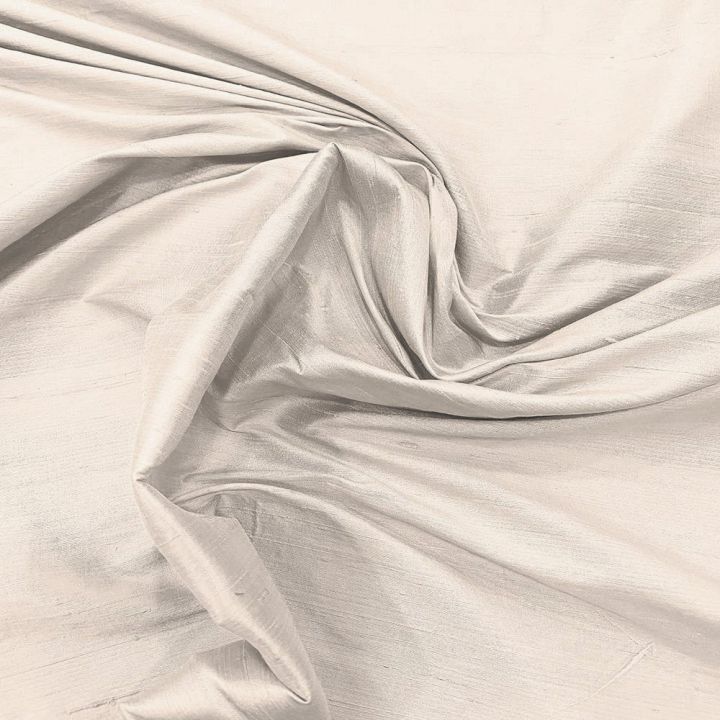
Classic dupion still has slubs, but fine and sparse ones that you sense more than see. Its sheen is more even, almost satin-like in the folds, as on our raw white dupion. On such a calm surface, the cut reads better, and it is the one we recommend when a garment needs to look crisp.
Which one for your project?
For a formal dress, a suit or a structured jacket, the classic, whose calm surface lets the cut speak. For a pleated skirt, a short jacket, cushions or curtains, the slub dupion, which gives texture to a simple piece. At a window, raking light brings its ribs to life through the day; just plan a lining, because silk dislikes the sun.
For a wedding, both have their place: a classic raw white for a smooth, luminous silhouette, a slub dupion in the same shade for a dress that wants more texture.
Sewing them: what changes (almost nothing)
Same silk, same weight, so the same settings. A Microtex 70/10 or 80/12 needle, a straight stitch of about 2 mm, pins placed in the seam allowances, because their holes stay in silk. Dupion frays quickly, so finish each seam as soon as it is sewn, with an overlocker or a French seam.
Cut all the pieces in the same direction. The sheen changes with the angle of the light, and two pieces laid head to tail would not be quite the same colour. With slub dupion, one more step comes before the scissors.
Nathalie’s tip: before cutting a slub dupion, unfold the whole length flat, right side up, near a window. Spot the most pronounced ribs and place your pieces accordingly, away from the centre back and the bust if you want discretion, or in full view on a collar or a pocket if you want them noticed.
One last question
Can you combine them in one garment?
Yes, and it is a nice way to use slub dupion in small touches. A classic dupion body and a collar, lapels or a belt in slub dupion of the same shade sew together without surprises. Just check that the colours match on two samples, because the same shade can differ from one family to the other.
The difference is easier to see than to describe, and it changes with the light. The simplest way is to order a sample of each and lay them side by side near a window, at different times of day. If you are still unsure about a particular project, write to us.
Happy sewing,
Nathalie
Shop the fabrics
Fabrics in this article
Related articles
You might also like

Silk momme: what is it, and how do you calculate it?
Momme measures how much a square metre of silk weighs. Where it comes from, how to work it out from our weights in g/ml, and what it does (or doesn’t) tell you about a fabric.

g/ml or g/m²: how to convert a fabric’s weight
g/ml tells you what the metre you buy weighs, g/m² what the fabric itself weighs. The formula, a table by width, and when to look at which.