
What is tweed fabric, and how do you sew it?
Tweed means two fabrics: Scottish wool cloth and the fancy tweed of the Chanel jacket. What our tweeds really contain, and how to sew them without relying on the iron.
Nathalie
Fabric Expert
9 min read
Tweed is a thick, mottled cloth of carded wool, born in Scotland. But the word now also covers a second fabric, the fancy tweed of the Chanel jacket, made of looped, metallic or sequined yarns in just about any fibre.
So tweed is not a fibre. Two “tweed” jackets can have no fibre in common, one in Hebridean wool, the other in polyester and acrylic. On our product pages, the name tells you nothing; the Composition line does.
Where does tweed come from?
From the Scottish and Irish countryside, where people wove a thick, rough wool made for wind and rain. The name probably comes from a misreading. A firm in Hawick, in the south of Scotland, sent a London draper, James Locke, an order for “tweel”, the Scots word for twill. In London it was read as “tweed”, like the river that runs through the region, and the cloth was sold under that name. The story is told everywhere, though accounts disagree on the date (around 1830, or 1841) and on whether it was a letter or an invoice.
Only one tweed has a legal definition, Harris Tweed. A 1993 Act of Parliament requires it to be handwoven by the islanders at their homes in the Outer Hebrides, from pure virgin wool dyed and spun in those islands. Donegal tweed, from Ireland, has no rule that strict, and you know it by the small flecks of bright colour caught in the yarn.
In the 1920s, Gabrielle Chanel asked Scottish mills for lighter, softer tweeds and moved the cloth from shooting clothes to town suits. Fancy tweed descends from those.
Wool tweed or fancy tweed: what’s the difference?
The first is a matter of wool, the second a matter of yarns.
| Wool tweed | Fancy tweed | |
|---|---|---|
| Fibres | wool | any: wool, cotton, polyamide, polyester, acrylic, viscose, metallic yarns |
| Yarns | carded wool, marled or flecked | looped, slub and ribbon yarns, metallic yarns, sequins |
| Weave | close, in twill, herringbone or checks | looser, textured |
| In the hand | dry, dense, a little rough | soft, textured, sometimes rough on the sequined side |
| Ironing | takes steam well and holds a press | handle with care (polyester, sequins) |
| Made into | jackets, coats, trousers, flat caps | short jackets, skirts, dresses, evening jackets |
Our tweeds, from 231 to 610 g/m²
At the time of writing, nearly half of the tweeds we have in stock are 100% polyester. The woolliest contains 30% wool, and the navy blue tweed blends six fibres at once, from acrylic to metallic polyester. The weights are more surprising still. Our product pages give them in grams per linear metre; brought back to the square metre to compare different widths, they almost triple from one end of the range to the other.
| Tweed | Composition | Width | Weight (product page) | ≈ g/m² | Iron (product page) |
|---|---|---|---|---|---|
| Navy blue tweed effect | 30% acrylic, 25% viscose, 19% polyester, 13% wool, 9% metallic polyester, 4% polyamide | 140 cm | 324 g/ml | 231 | do not iron |
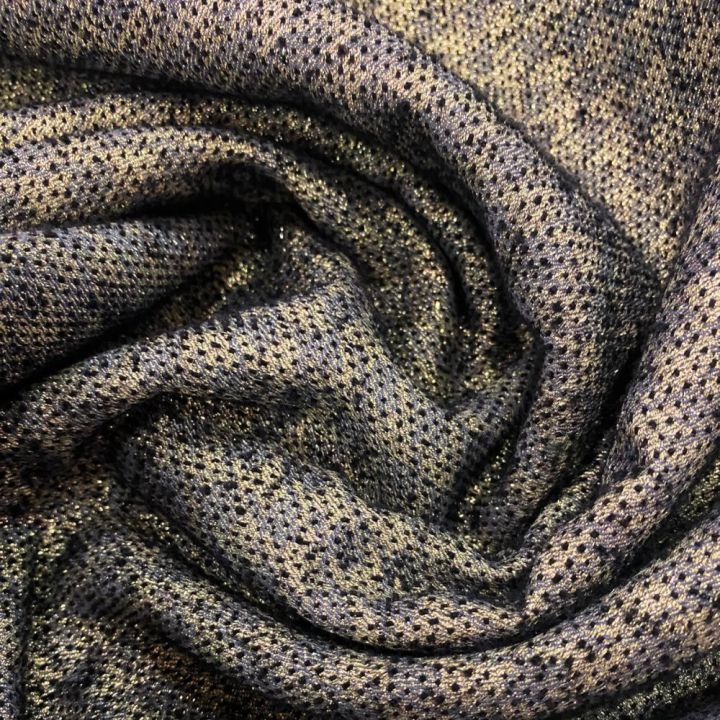
| Electric blue fancy woven (Italy) | 79% polyamide, 15% virgin wool, 6% cotton | 140–144 cm | 420 g/ml | 296 | cool iron |
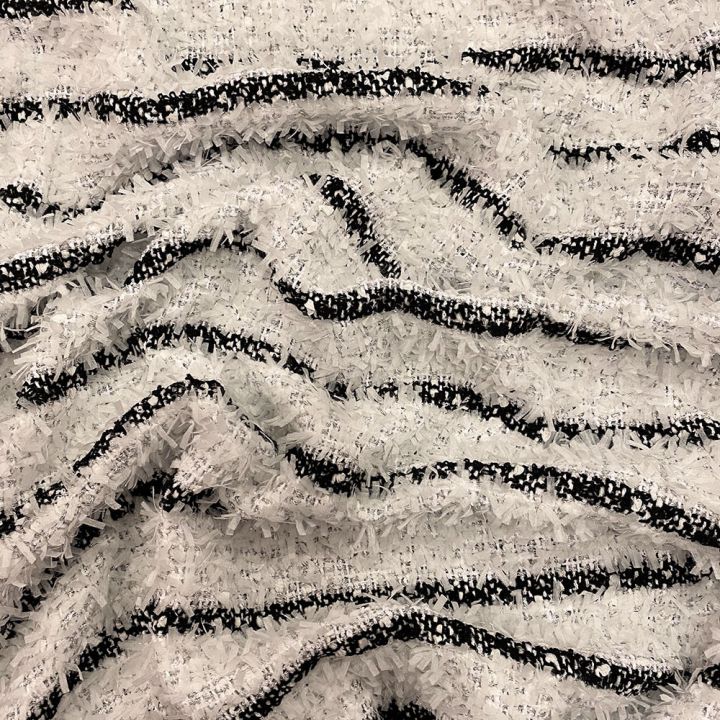
| Black and white stripes (Italy) | 40% cotton, 40% polyamide, 9% polyester, 6% viscose, 5% acrylic | 135–138 cm | 420 g/ml | 308 | cool iron |
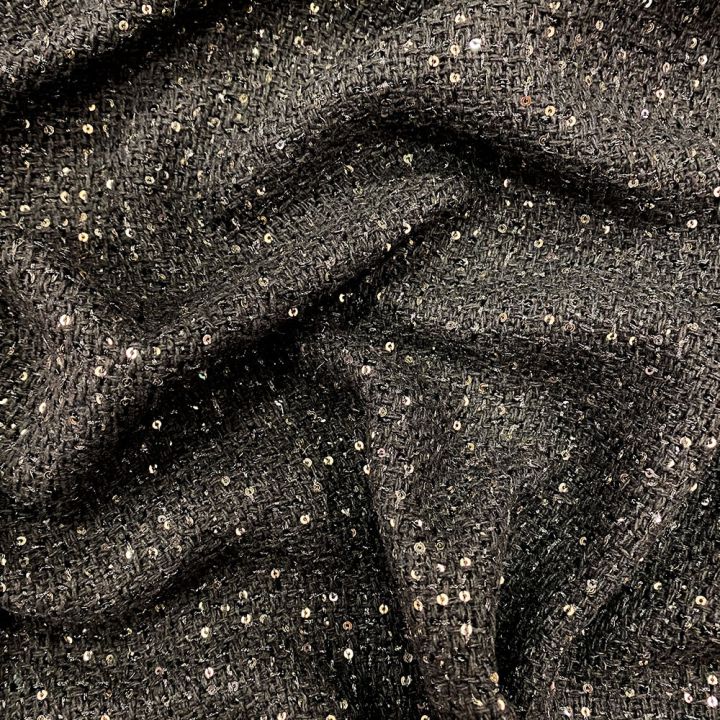
| Ivory with small silver sequins | 90% acrylic, 10% polyester | 145–150 cm | 638 g/ml | 433 | do not iron |
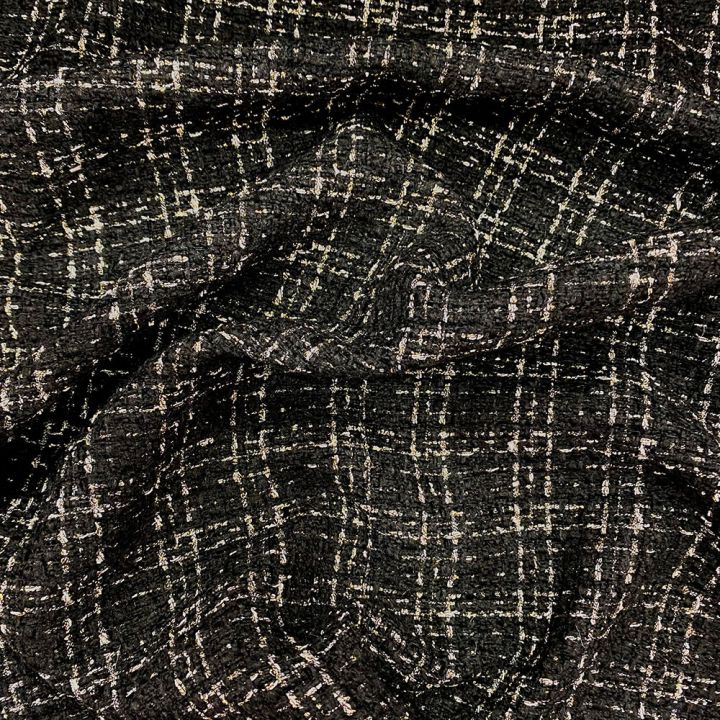
| Black and gold threads | 70% polyester, 30% wool | 145–150 cm | 754 g/ml | 511 | do not iron |
| Black with gold glitter | 100% polyester | 145–150 cm | 900 g/ml | 610 | do not iron |
The weight per linear metre is divided by the middle of the width, as on our product pages. At around 300 g/m², the two Italian tweeds weigh what a jacket wool does. Sold under the same name, the black with gold glitter tweed, gold sequins in fact, weighs twice as much, as much as a coating cloth. Check the width too before working out how much to buy. Most are 140 to 150 cm wide, but the duck blue sequined one is only 120–125.
Look at the last column too, because it changes the way you sew.
What can you make with tweed?
The short collarless jacket first, the one everyone has in mind. It has few pieces, no lapels to shape, and its edges are finished with braid or with a fringe made by fraying the tweed itself. Our tweeds at around 300 g/m² suit it best, as they do a straight skirt or a pinafore dress.
The heaviest make evening jackets and short skirts that hold their shape. Line them: a sequin rubs the inside of your arm all evening, and tights catch on it. And don’t ask a fancy tweed to stand in for a winter coat. Usually woven more loosely than wool tweed, it lets the air through; it is a fabric for spring, autumn and evenings out.
How do you sew tweed?
A fancy tweed frays the moment you cut it (the edge yarns come loose the first time you move the piece) and distorts if you pull it. Everything else follows from that.
Cutting and neatening
Cut in a single layer and lay all the pieces in the same direction, to be safe: an iridescent tweed doesn’t always reflect the light the same way in both directions. Keep an old pair of scissors for the sequined ones, because sequins blunt the blades and skitter across the table like confetti. On a stripe such as our black and white striped tweed, line the stripes up at the side seams and centre front, and allow a little extra fabric. Leave 2.5 cm seam allowances rather than 1.5: tweed frays, and the extra margin lets it lose a few yarns without reaching the seam. Neaten each piece as soon as it is cut, with a zigzag or an overlocker, except on a sequined edge, where the overlocker’s blades would meet the sequins. Staystitch the neckline and armholes too, in the seam allowance a few millimetres from the seamline, so they don’t stretch while you make up the jacket.
Which needle for sewing tweed?
An 80/12 for our lighter tweeds, a 90/14 above 400 g/m² and wherever the needle has to go through sequins. Start with a new one and change it once the jacket is finished, as metallic yarns and sequins wear it down quickly. Lengthen the stitch to 3 mm, 3.5 mm on the thickest, sew with polyester thread and, if your machine has one, fit the walking foot, which feeds both layers together so the tweed doesn’t ripple.
On a sequined tweed, thread-trace the seamline with tacking, then remove the sequins from the seam allowance before stitching. The seam will lie flatter, scratch less, and you will break fewer needles.
Nathalie’s tip: to remove a sequin without loosening its neighbours, cut it from the edge to the hole with small scissors, then pull out each half with tweezers. The thread holding them stays intact. Keep an offcut of the tweed; once the jacket is made up, take a few whole sequins from it and sew them back by hand wherever a seam looks bare.
Sewing without relying on the iron
For ten of our thirteen tweeds in stock, the product page advises against ironing. It is a precaution, and we follow it here: metallic yarns and sequins, which are plastic, don’t take heat well, and polyester turns shiny under an iron that is too hot. The two Italian tweeds in the table accept a cool iron, one dot, under a pressing cloth and on the wrong side.
The classic methods, though, open seams with steam and a tailor’s clapper. Without an iron a seam stays a little rounder, and it is thread, sewn by hand, that holds it flat.
Fusible interfacing, which goes on with a hot iron, is therefore out. On a sequined tweed, underline each piece with silk organza instead, as couture sewers do for beaded and sequined fabrics. Cut each piece a second time in organza, tack the two layers together by hand in the seam allowance, with one or two lines through the middle of large pieces, then sew them as one. The organza doesn’t show, it keeps the heavy fabric from sagging, and it firms the whole up a little, which suits a skirt or a structured evening jacket. Above all, it gives you a layer to sew down what the iron would have held.
Open the seams with your fingertips, pressing hard, then hold each seam allowance to the organza with a hand catch stitch, without going through the tweed. Do the same for the hem. Nothing will show on the right side.
On a tweed without sequins, we have a soft spot for the method of Chanel’s haute couture jackets, which many sewers use for the Chanel-style jacket. No fusible and no tailoring canvas: apart from a little organza on the fronts and along the edges, it is the lining, a silk satin or a silk crêpe, that gives the tweed its structure. It is quilted onto each piece before assembly, with lines at a 4 mm stitch that follow the straight grain or a line of the weave so they disappear, and stop 2.5 to 5 cm short of the seams and hem. The tweed is then joined on its own, its seams opened with steam in the workrooms, or with your fingers if you follow the product page, and the lining is closed over them by hand. It takes time. But the jacket hangs softly and wears like a cardigan, where organza over every piece would stiffen it. On a sequined tweed the machine would hit a sequin on every quilting line, so stay with the organza.
One last question
Is tweed itchy?
Wool tweed often is, a little. On ours, it is rather the sequins and metallic yarns that prickle, on the wrong side. A lining settles the matter, and to choose one, we compared cupro and acetate.
For a first jacket, we recommend a tweed without sequins, among the lighter ones. It takes quilting well, doesn’t break needles, and it is the one on which you will learn to do without the iron. The sequins can wait for the second.
Happy stitching,
Nathalie
Shop the fabrics
Fabrics in this article
Related articles
You might also like

Silk velvet vs cotton velvet: which one to choose?
Same price per metre, two fabrics with almost nothing in common. What silk velvet is really made of, what gives cotton velvet its body, and how to sew each one.

Satin vs silk: what’s the difference?
Satin is a weave, silk is a fibre. Six satins from our shelves compared, from polyester to silk, and the reliable ways to tell whether a satin is really silk.

Best lining fabric: cupro or acetate, garment by garment
Cupro or acetate? What our two linings are really like, their actual weights and care, and which one to choose for a coat, a jacket, a dress or a skirt.